
Complete Valuation
A verified value for your business, from your documents.
Someone across the table will name a price for your business whether you know yours or not. This report puts a verified number in your hand first. Your earnings are rebuilt from your tax returns and priced against recorded sales of businesses like yours. $849 flat.
Not an appraisal. Built for an owner's own planning. What an appraisal is for, and what this is for, is spelled out at the bottom of this page.
300+
Valuations run
43%
Cheaper than a standard valuation firm
24 hours
From complete documents to your report
Every one run start to finish on the same standard your report uses. How the standard is checked
What it costs to not know your number
Three ways the pricing conversation goes wrong when the other side has a number and you do not.
The anchor
Their number lands first
The first price named sets the starting point for every number after it. Let a buyer name yours first, and you spend the conversation arguing up from his figure.
The lowball
An offer you cannot answer
A low offer only sticks when you cannot answer it with evidence. Without recorded sales behind your price, it is your word against theirs.
The free guess
Worth what it costs
Free calculators price your business from the numbers you type in, exactly as typed. Nothing is checked, and no recorded sale is shown. The answer carries exactly the weight of the checking behind it.
Why this number holds up
Three things stand behind every range we print.
The documents
Verified, line by line
Earnings are rebuilt from your tax returns, not from a form you fill in. Every add-back needs a document behind it, or it is named as a gap in the report.
The evidence
Recorded sales, with sources
The range is priced against recorded sales of businesses like yours, each one with its source, so the evidence can be checked instead of trusted.
The review
Checked against the standard
The finished range is checked against the recorded sales and the earnings build before anything leaves.
What the number is built from
Comparable sales are one input, not the whole method. Before a range is printed, the standard works through every factor below, each one grounded in your documents or in recorded evidence.
The returns
Three years of tax returns
Your earnings are rebuilt from the returns, line by line. The work starts from what you filed, not from a number typed into a form.
The add-backs
Every one tested
Each add-back you claim needs a document behind it. Anything the documents cannot support is named as a gap, never quietly counted.
Your job
A salary counted before profit
The cost of hiring someone to do the job you do is counted first, so the earnings being priced are the earnings a buyer would actually keep.
The sales record
Recorded sales, with sources
Businesses like yours that actually sold, what they sold for, and where each record comes from, printed in the report where they exist.
Your industry
Evidence for your line of work
The pricing evidence is built for your specific industry. A cleaning company and a software firm are not read off the same generic table.
The trend
Revenue, year over year
Whether your sales are growing, holding, or slipping across the three years, and what that direction does to the value.
The margins
Yours against your industry
Your profit margins are set against what is normal for businesses in your line of work, so a strong or weak margin is priced as what it is.
The customers
Who the revenue rests on
How much of your income comes from a few customers, and how much of it would be at risk if one of them left.
The owner
How much runs through you
The work, the relationships, and the know-how that live in you personally, and how much of the business would be left if you stepped away.
The revenue
Recurring against one-time
Income that renews on its own is worth more than work that has to be won again every month. The mix between the two is part of the price.
The team
The people a buyer inherits
The depth of your staff and your key people, and whether the business can run on them with you out of the middle.
The lease
Where the business sits
The facility and the lease terms behind it, because a buyer inherits the location and the time left on the clock.
The equipment
Assets, treated separately
Equipment and other assets are accounted for on their own. The report prices the business itself, and it never prices real estate.
The debts
What the business owes
Loans and obligations a buyer would take on are counted, so the value reflects the whole picture and not just the top line.
The documents
The strength of the file itself
How well your paperwork supports the numbers sets how narrow the range can honestly run. Where the evidence runs thinner, the range runs wider, and the report says which basis yours stands on.
Why it costs what it does
Depth is the product
A free calculator takes one number and multiplies it. This work rebuilds the number first, then tests it from several directions: against your own filed returns, against the sales record, and against what is normal for your industry. That is the difference between a guess with a dollar sign and a valuation you can negotiate from, and it is why the report is priced like professional work instead of given away.
How it works
Four steps. No sales call to sit through first, and nothing moves before payment.
1
Pay the flat fee
$849 for the report, $999 with Exit Roadmap. The fee is never credited toward a deal.
2
Go straight to your upload page
Payment opens your secure document upload on the spot. The page lists exactly what to send: tax returns, current financials, and the support behind each add-back.
3
Send your documents
The moment the set is complete, your 24 hours start, never from the day you pay. If anything is missing, your page names it there, and sending it costs nothing extra.
4
Your report arrives
Inside that window. Exit Roadmap buyers also get the fix list with it: what to fix, in what order, and what each fix is worth where the evidence supports a figure.
Start when you are ready.
Send your documents, and your report arrives within 24 hours of the complete set arriving. No sales call first.
Look inside before you pay
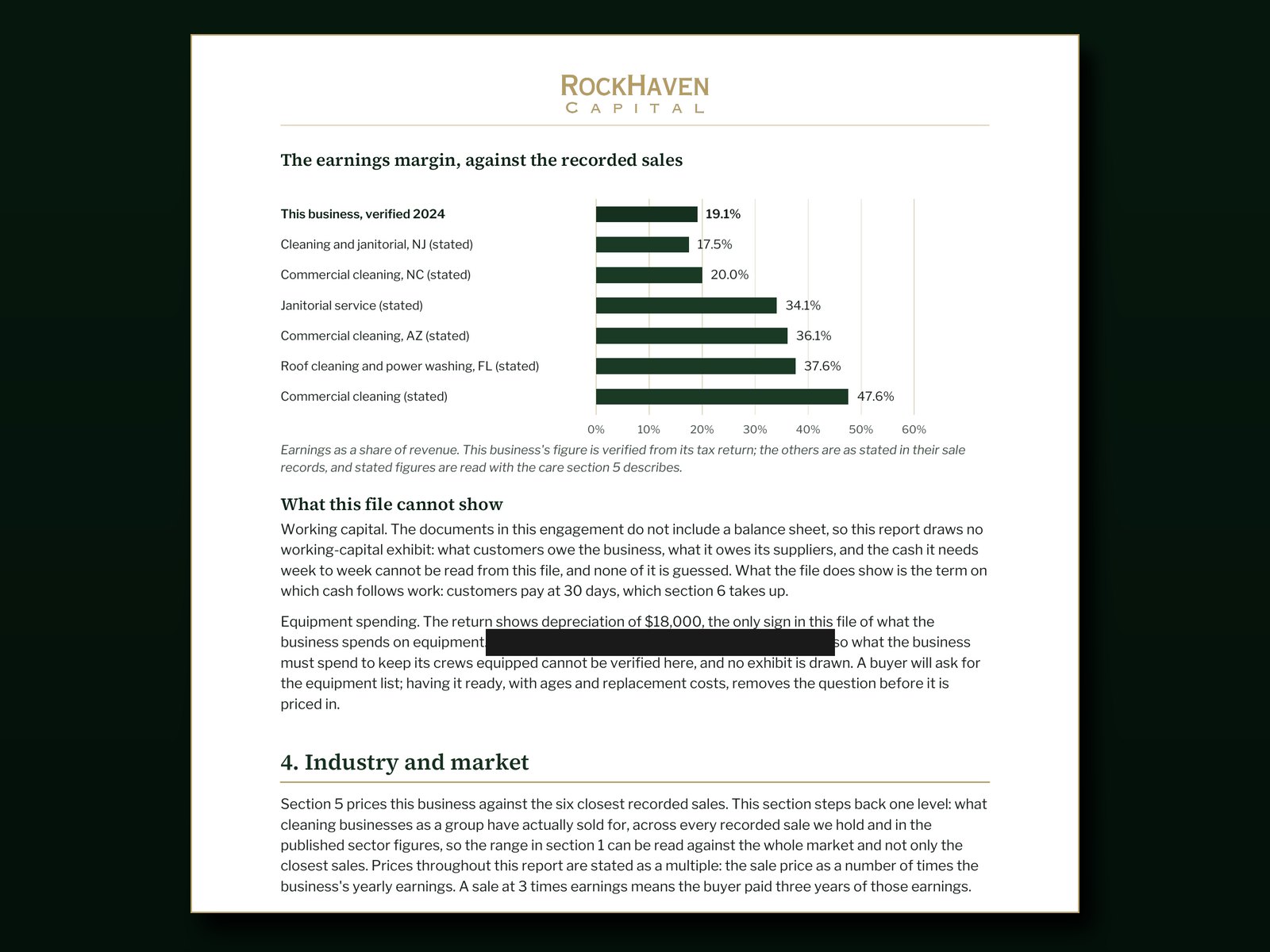
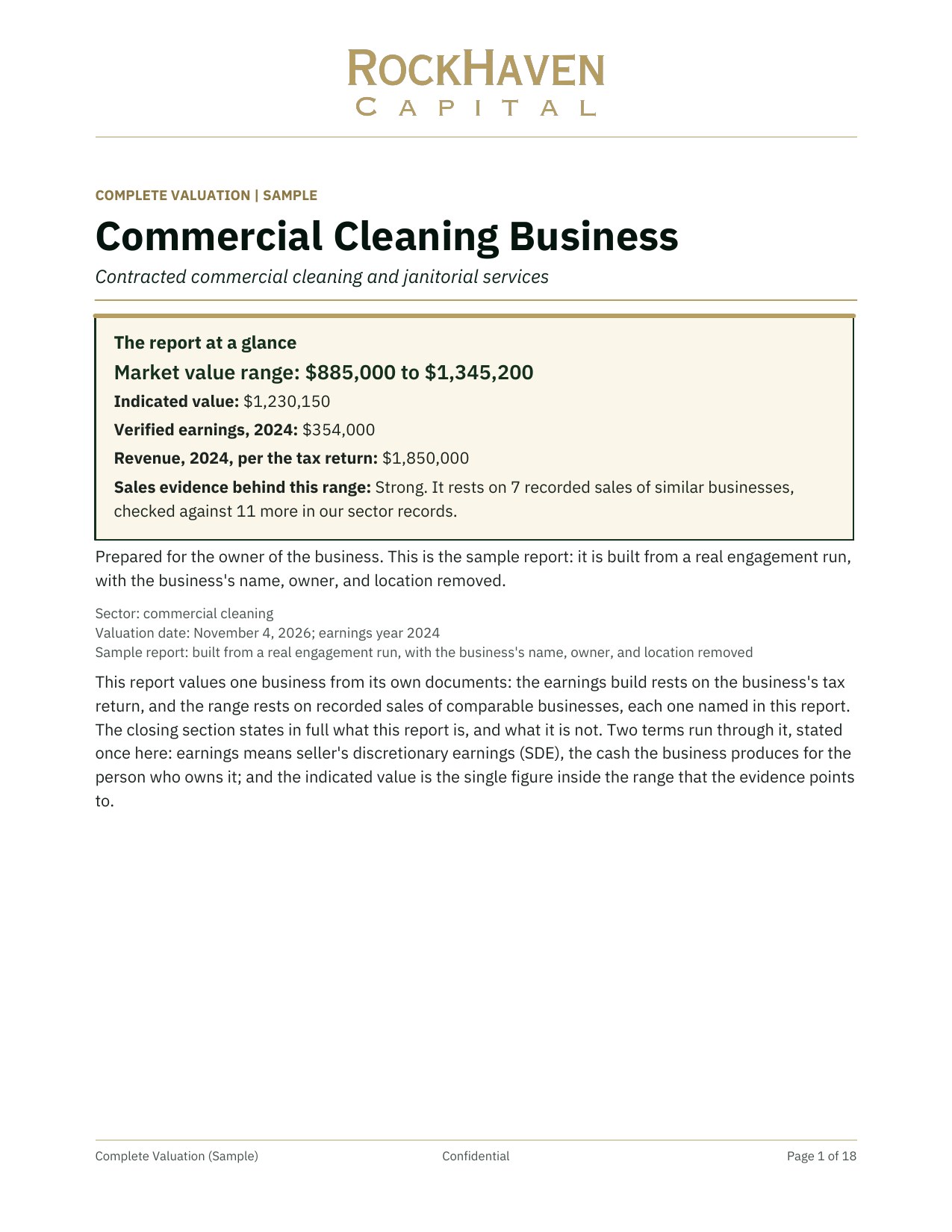
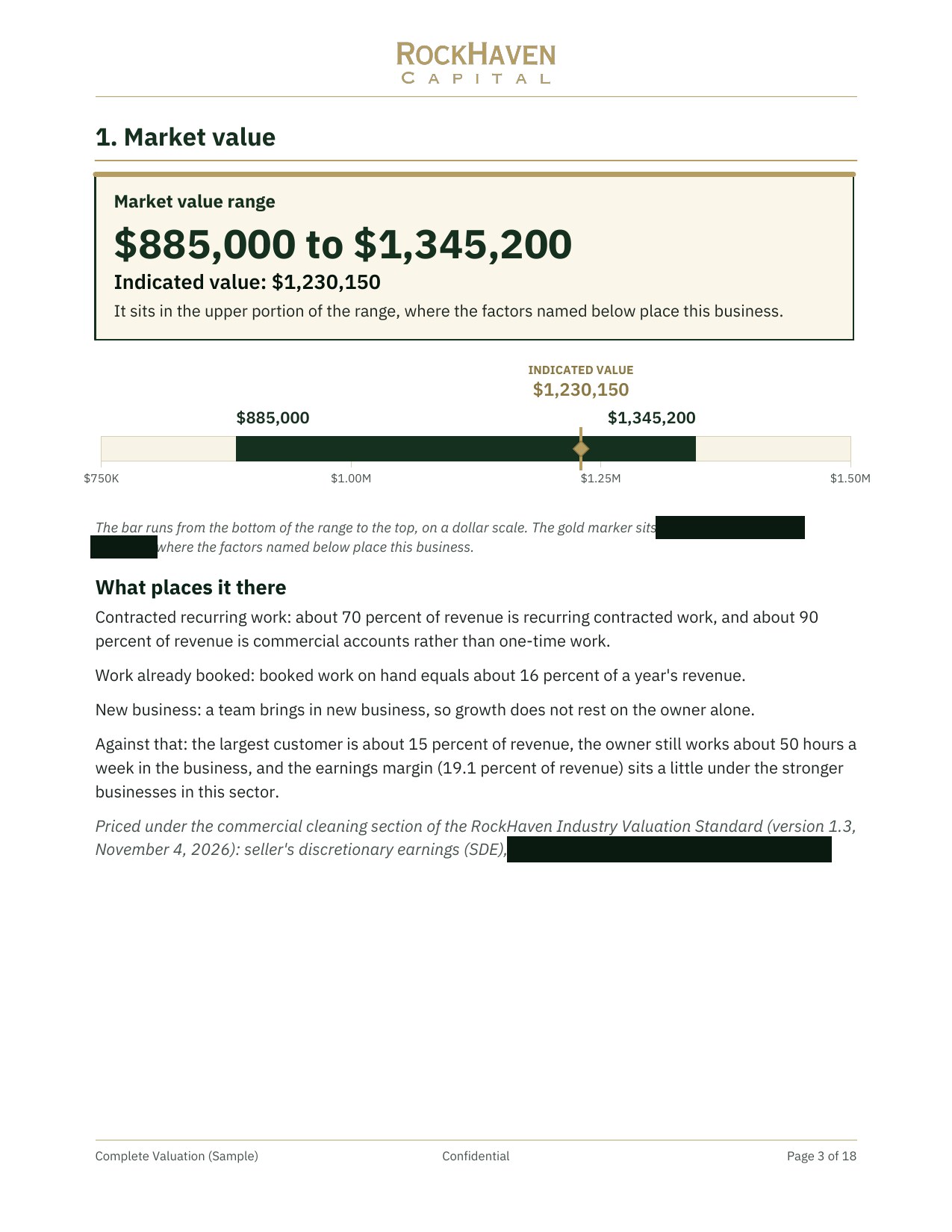
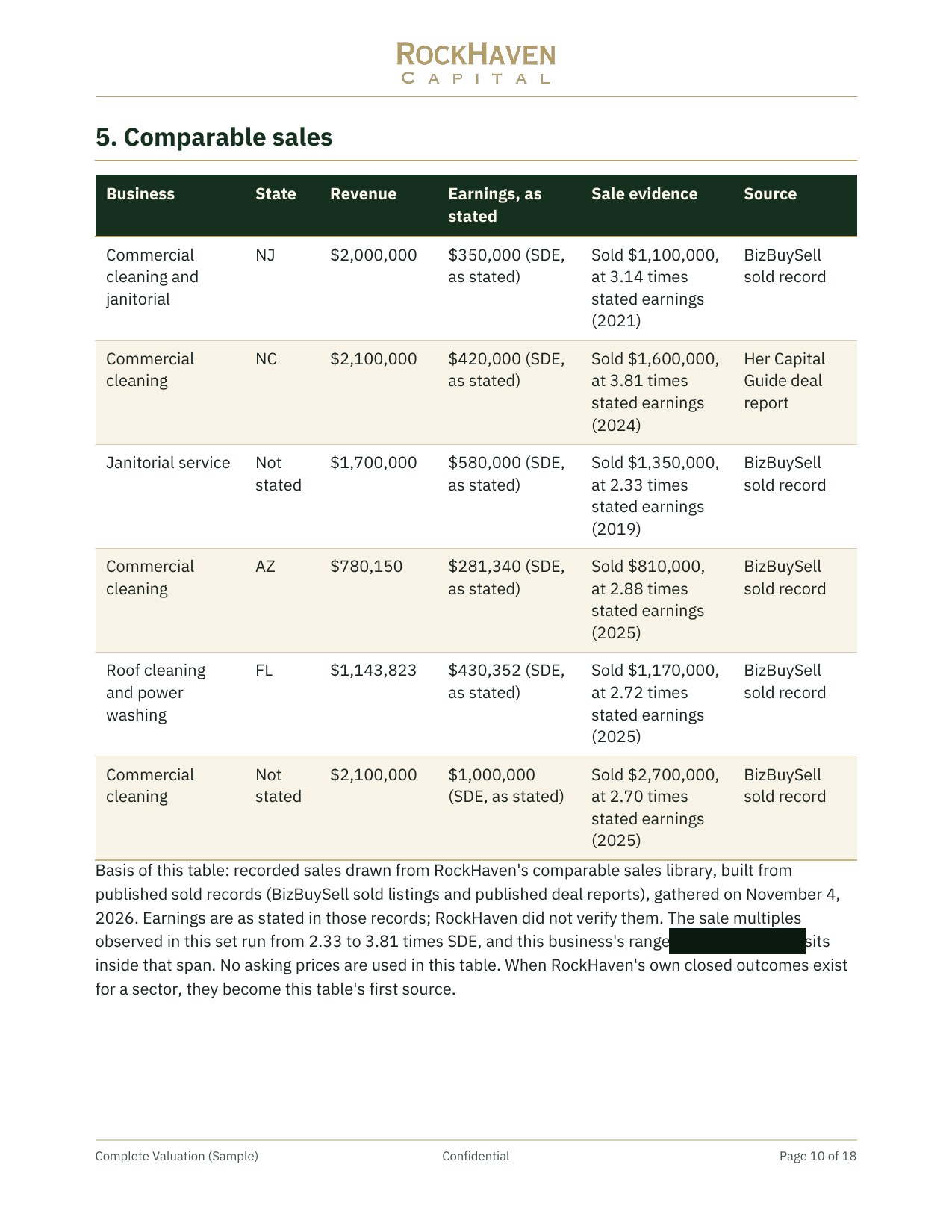
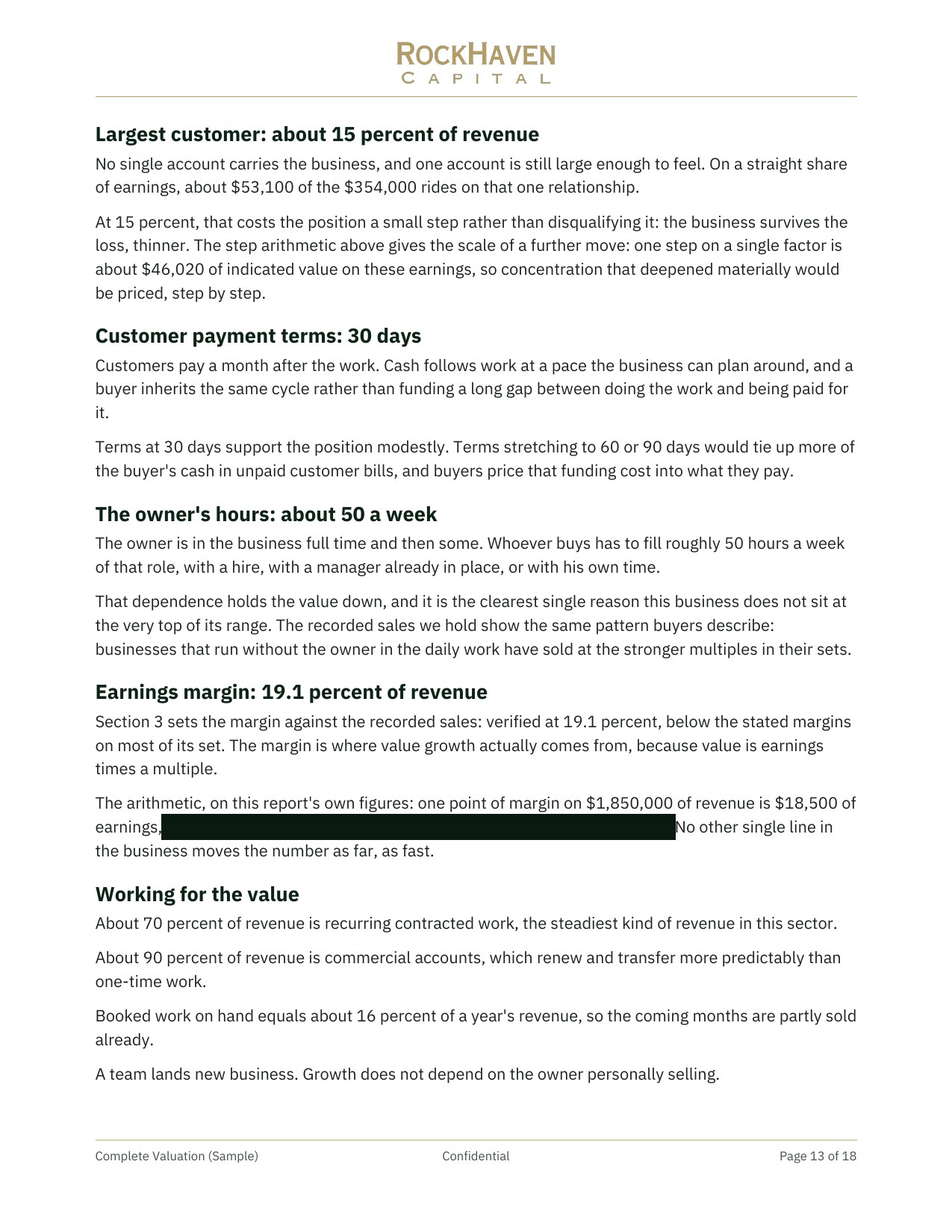
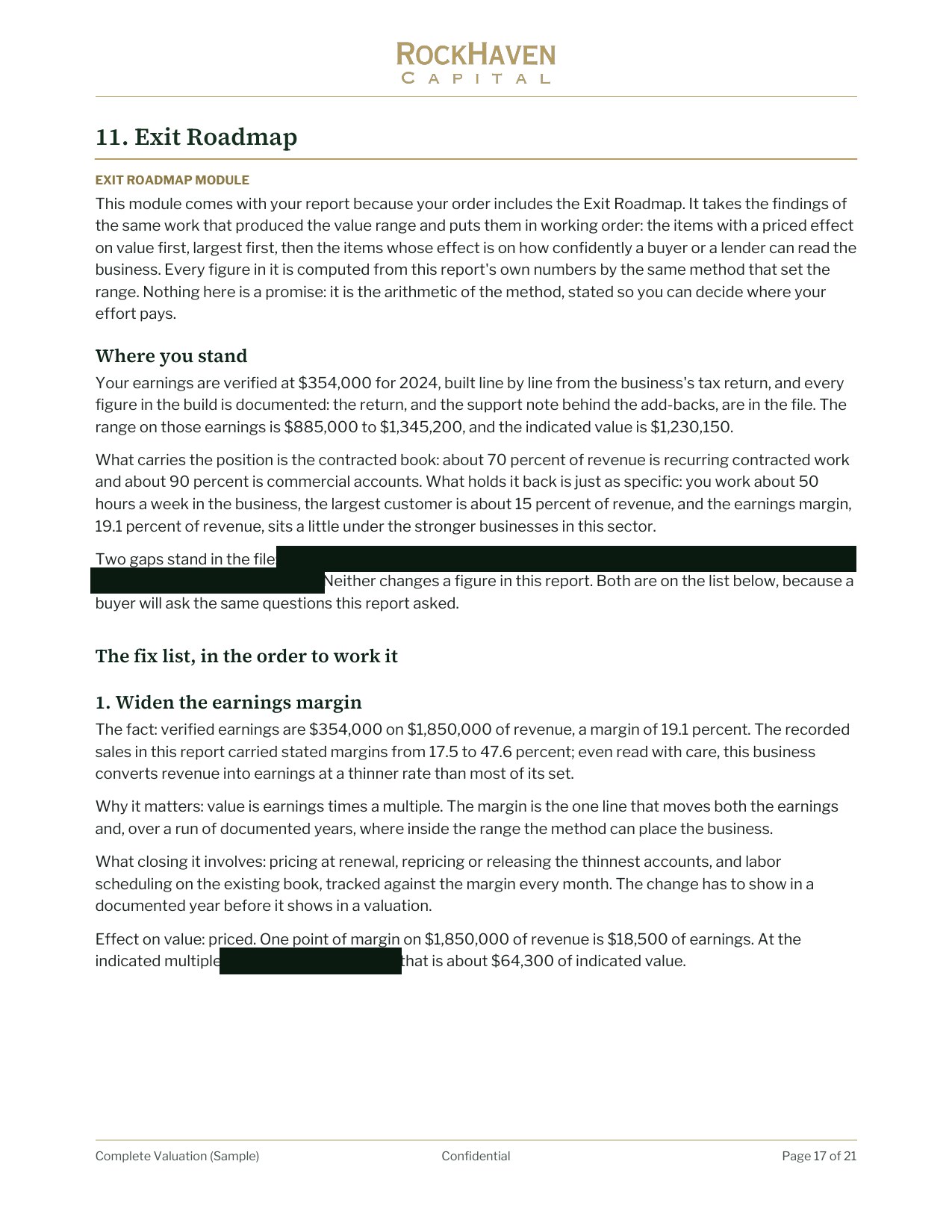
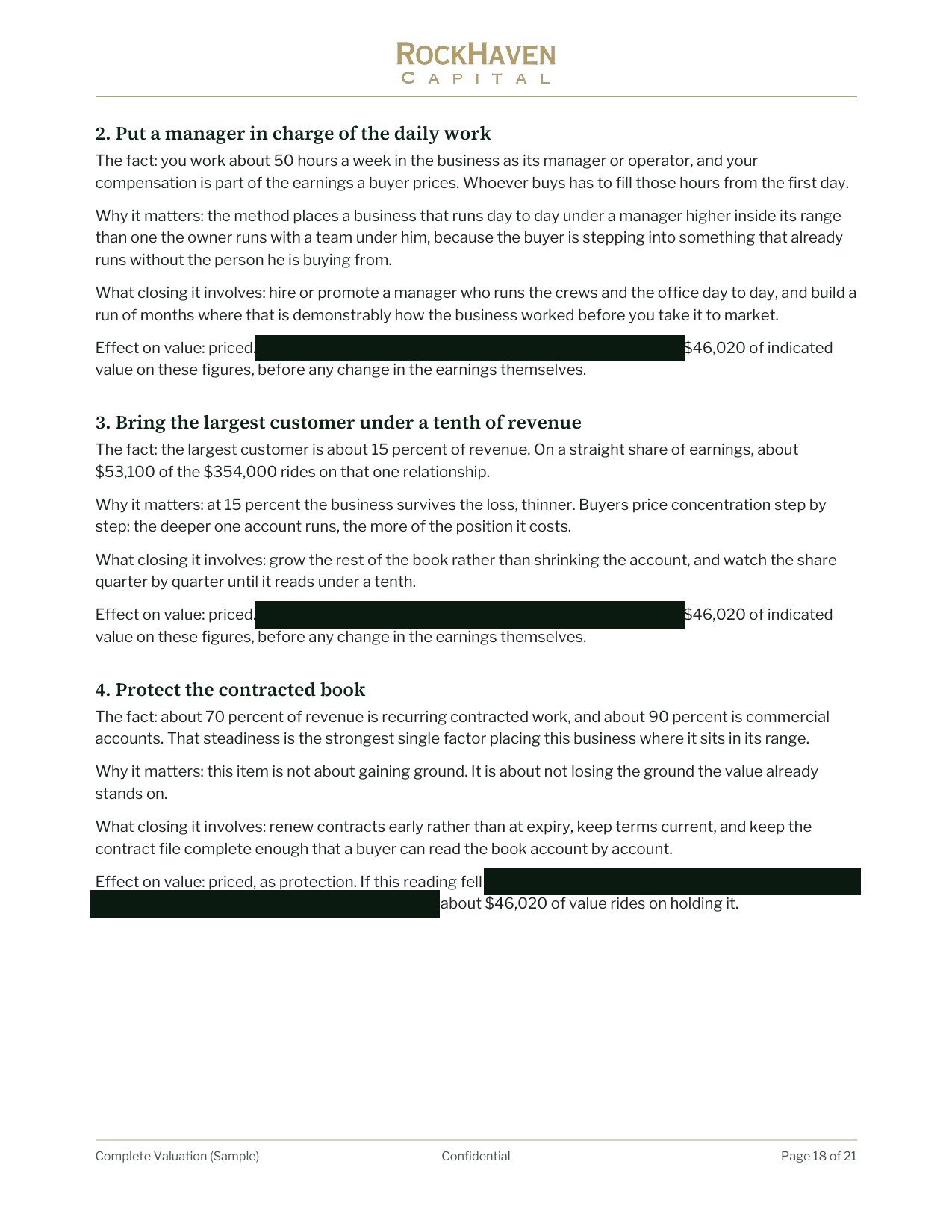
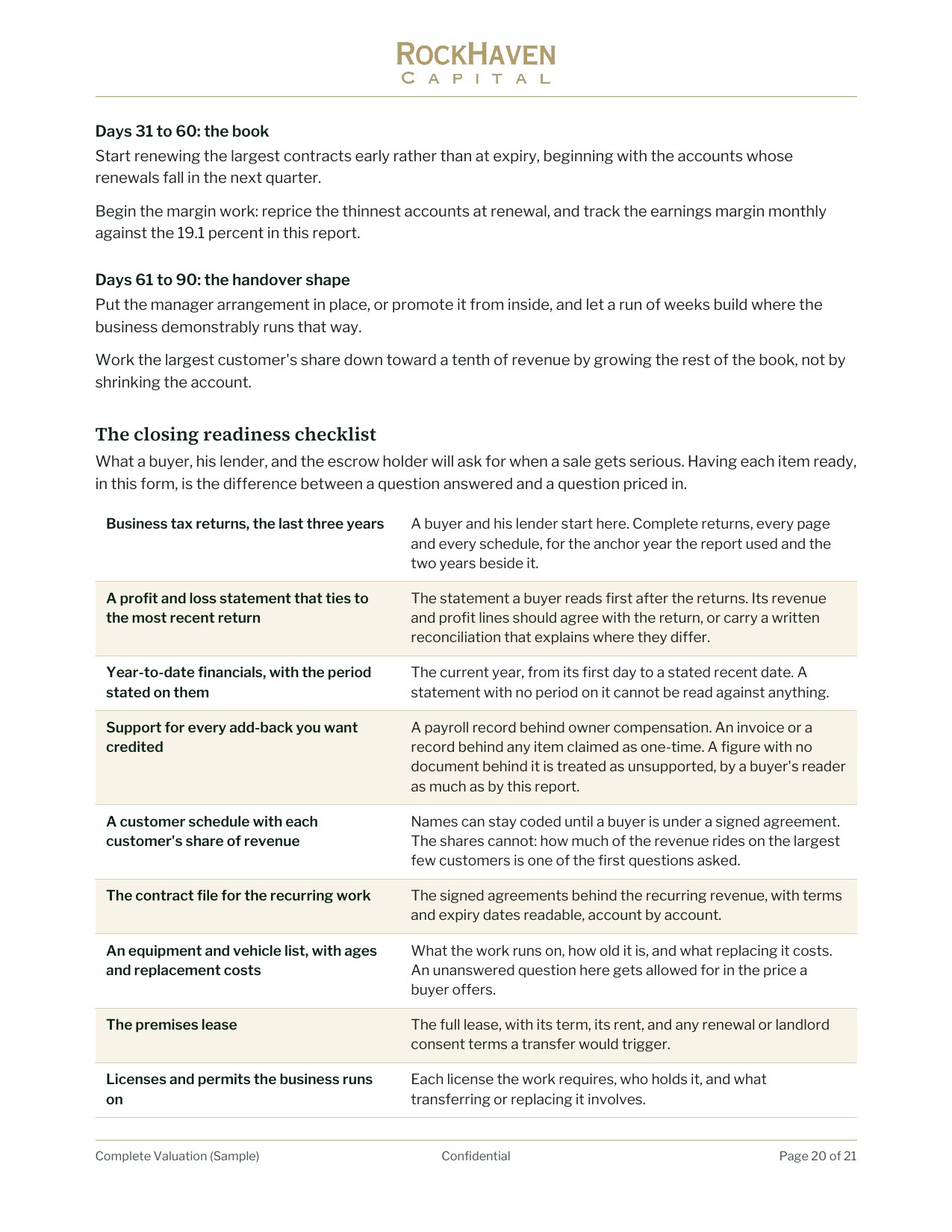
Pages from a sample report. The business is anonymized and its figures are illustrative. What you can see here is the shape of the answer: the range, the value inside it, and the recorded sales the range rests on. The full report, built from your documents, is what the fee buys. A typical report runs 18 to 24 pages for a documented business. These are four of them, shown whole.
One standard, run hundreds of times before your report
The standard behind every report has been run more than 300 times, against real businesses and against recorded sales, with nothing picked after the fact. Every run works the same steps your report works: the earnings build, the range, and the position inside it.
The honest limit, in the same breath: the test runs were measured on the earnings stated in their sale records, because no one can re-verify a stranger's books after the fact. What those runs prove is the standard. Your report runs the same standard on the stronger input: your own documents, verified line by line.
The same standard we buy on
Every report is built the way we evaluate a business we might buy ourselves. Same documents. Same earnings rebuild. Same recorded sales. There is one difference. When we run that work for ourselves, it stays internal. You see an offer, not the work behind it. When you buy the report, the work is yours.
Yours to keep.
Take it to another buyer, your banker, or your family. It is yours whether or not we ever do a deal.
A buyer's view of your business.
What a buyer checks, what he questions, and what moves the number, shown plainly.
The start of a plan.
Most owners have no succession plan. The report shows what is holding your price back. The Exit Roadmap add-on turns that into a fix list, in the order to work it.
The same work, in your hands.
One flat fee, and the report is yours to keep whether or not we ever do a deal.
What lands in your hands
One report, written to be read by an owner, not by an accountant. All nine pieces below are in the $849 report. The bundle adds one more, the Exit Roadmap fix list, in its own section right after this one.
The number
A market value range
The range, the one value inside it that the evidence supports, and the reasons it lands where it does, in plain words.
The earnings
Verified, line by line
Your profit, rebuilt from your tax returns. Every add-back is its own line, with the document that backs it up. Anything the documents cannot back up is named as a gap, never smoothed over.
The analysis
Your year, in plain numbers
Your margins and add-backs, and how your margin stacks up against businesses that actually sold. Plus a straight statement of anything your file does not show.
The evidence
Comparable sales, with sources
Businesses like yours that actually sold, what they sold for, and where each record comes from.
The market
Your sector's real sales
Every recorded sale we hold in your line of work, plus the published figures for your sector, each one with its source and date. Your range is set against the whole market, not just the closest sales.
The drivers
What moves your value
What is helping your value and what is hurting it, tied to how your business actually runs day to day.
The what-ifs
The value, if things change
What happens to the value if earnings rise or fall, or if your strongest point weakens. Every line is marked a what-if, not a prediction.
The method
Shown, with the evidence behind it
The standard we followed and its version, and how many recorded sales stand behind the range for your industry, with the counts shown.
The proof
Exhibits, in full
The schedules at the back, complete: the full earnings build, the list of every document the report rests on, and the full what-if grid, every cell printed.
The stack, plus one
Complete Valuation + Exit Roadmap: $999
Everything above, plus the Exit Roadmap fix list. The fix list turns the report's own findings into a prioritized list of what to fix, each fix priced where the evidence allows. The next section shows the module itself, with sample pages from a real report.
The Exit Roadmap fix list
The report tells you what your business is worth. Exit Roadmap tells you what to do about it.
It takes the findings already inside your report and turns them into a work list, in the order to work it. Each item names what a buyer will find, why it moves your price, and what closing it involves.
Where a fix carries a dollar effect the evidence can support, the effect is printed next to the item. Where it cannot, the item says so plainly. Nothing is padded with invented numbers.
Owners use it as the plan for the year before a sale, or as the checklist for making the business worth more whether they sell or not.
The module runs four to six pages inside the report. The sample below runs five pages. It opens with where you stand, then works the fix list in order, and closes with a 90-day plan and a readiness checklist.
What the same answer costs elsewhere
Four ways to price the same question, drawn on one scale.
Free online calculator
Free to about $750
RockHaven Complete Valuation
$849 flat
Standard valuation firm
Typically $1,500 to $4,000
Certified appraisal
Typically $7,000 to $8,000 or more
| Compared on | RockHaven Complete Valuation | Standard valuation firm | Certified appraisal | Free online calculator |
|---|---|---|---|---|
| Built from your documents, verified | Yes. Tax returns first, every add-back shown with its support | Yes, the firm works from your financials | Yes | No. It uses the numbers you type in, exactly as typed |
| Comparable sales shown, with sources | Yes. Recorded sales, each one sourced | Usually summarized. Sources are not always shown | Yes | No |
| Checked before it ships | Yes. Every report is checked against the standard | Varies by firm | Yes. A credentialed appraiser signs it | No. No human sees it |
| Turnaround | 24 hours from complete documents | Varies by firm | Varies by firm | Instant |
| Usable for tax, lending, ESOP, or court | No, and the report says so on its face | Only when the provider holds the credential that use requires | Yes. That is what it is for | No |
The verdict
The calculator is the only free answer, and the only one that checks nothing. The appraisal is the only one a lender or a court can use, and it is priced for that work. This report is the one priced for an owner: documents verified, sales shown, $849 flat.
Market figures: published valuation cost guides and provider pricing pages, including the BizWorth 2026 cost guide, checked November 2026. Where practice varies by firm, the cell says so rather than guessing.
Which one do you need?
The same report either way. The difference is what comes with the number.
The bundle Recommended
Complete Valuation + Exit Roadmap
$999 one time
Everything in the report, plus the Exit Roadmap fix list: the changes that would raise your value the most, in the order to make them, with the value effect stated wherever the data supports one.
Buy the Complete Valuation + Exit Roadmap: $999The report
Complete Valuation
$849 one time
The full report described above: the market value range and the value inside it, the verified earnings build, the comparable sales with sources, the sector evidence, what moves your value, the sensitivity view, and the exhibits in full.
Or add Exit Roadmap on the payment page: $150 more, the same $999 total. Buy the Complete Valuation: $849Questions before you order? Book a free 15-minute questions call.
After you pay, you go straight to your secure upload page, and the page itself lists what to send. Your 24 hours start when your documents are complete. Your report arrives by email, and stays available as a download on that same page. Have a promotion code? Enter it on the payment page, before you pay.
Step three, later
Valuation Tracker: $249 per year
For report customers only. An annual re-run on fresh documents: an updated range, a value bridge showing what moved since the last report, and a refreshed comparable set. It is offered when your report is delivered. There is no public checkout, because it starts with a report.
Selling your business to RockHaven is a separate thing, on the acquisition side of the firm, and it costs a seller nothing. These reports are a paid service for owners who want the number first, whatever they decide later.
Priced from recorded evidence.
The evidence
Every range is priced from the recorded sales behind the standard for your industry. When solid comparable sales exist for a business like yours, they are used in the pricing and printed in the report, with the count shown. Where a business is too niche for comparable sales, no sales are printed, and the range is priced on the industry multiples in the standard. The range runs wider where the evidence runs thinner, and the report says which basis your range stands on.
Your documents
If your documents have gaps, we name exactly what is missing instead of guessing around it. Send the missing pieces and your report runs again at no charge, because nobody should pay twice for the same report.
Questions before you buy?
Book a free 15 minute call and ask them. It is optional, never a step in buying, and plenty of buyers skip it. The report is the same either way.
Straight answers, before you pay
The questions owners ask about this report, answered straight.
01
Is this an appraisal?
No.
This is a valuation report, built for an owner's own planning. No licensed or certified appraiser prepares or signs it. If your number has to serve a lender, the IRS, an ESOP, or a court, you need a credentialed appraiser, and we will tell you that before you pay.
02
What documents do you need?
Three years of business tax returns. Your current year financials. The support behind any add-back you claim. Your secure upload page lists the set for your business, right there on the page, the moment you pay.
03
How long does it take?
24 hours from the moment your complete documents arrive. The clock does not run from the day you pay.
04
What if my documents are thin?
The build starts from your tax return, which is the strongest document most owners have. Anything the documents cannot support is written into the report as a documentation gap, in plain words. If the evidence cannot carry a number at all, the report says so, and shows what would close the gap.
05
Does buying a report affect selling to you?
No. The report is a paid service on its own terms, and the fee is never credited toward any transaction. One disclosure, in the open: RockHaven also buys businesses, and your report is built on the same valuation standard we buy on. If you later sell to us, that runs on the acquisition side of the firm, and selling to us costs you nothing.
06
Why not just use a free online estimate?
Because a free estimate prices the numbers you type in, exactly as typed. Nothing is checked against a document, and no recorded sale stands behind the answer. Our own free sellability check works that way too, and it says so on its face: five minutes, from your answers alone, no documents needed. It is a fair starting point. It is not a number to negotiate with.
07
My broker already gave me a number. Why is this different?
Ask for the working behind any number you are handed: the earnings build and the recorded sales it rests on, each with its source. A broker's opinion rarely arrives with that document, because the document is not what he sells. This report is the document. Your earnings are rebuilt from your returns. The comparable sales are shown with their sources. Every report is checked against the standard before it leaves. One more difference: a broker earns when your business sells. This fee buys the report alone, and it is never tied to any sale.
08
What happens after I pay?
Payment takes you straight to your secure upload page. The page lists what to send: tax returns, current financials, and the support behind each add-back you claim. If anything is missing, the page names it there, and sending it costs nothing extra. The moment your documents are complete, your 24 hours start. We verify the build and check it against the standard. Then your report is ready to download from that same page. Complete Valuation + Exit Roadmap buyers get the fix list with the report: what to fix, in what order, and what each fix is worth where the evidence supports a figure.
09
My books are messy. Does this still work?
In most cases, yes.
The build anchors on your filed business tax returns, which are fixed even when the day to day books are not. Your current year figures are reconciled against those returns before anything is priced. Where the two disagree, the report shows the difference and prices from the filed record.
10
What if you cannot find comparable sales for my business?
Your business is still valued, and you are not turned away for a thin comp set. When solid comparable sales exist for a business like yours, they are used and printed in the report, with the count shown. Where a business is too niche for comparable sales, no sales are printed, and the range is priced on the industry multiples in the standard. The range runs wider where the evidence runs thinner, and the report says which basis your range stands on.
Questions before you order? Book a free 15-minute questions call.
Know your number before the other side names theirs.
One flat fee. No sales call first. Your report arrives within 24 hours of your complete documents arriving.
The fine print, in plain sight
Not an appraisal. This report is a valuation report prepared for the owner's own planning. No licensed or certified appraiser prepares or signs it.
Not for lending, tax, ESOP, or court use. If that is your purpose, you need a credentialed appraiser. Say the purpose before you pay: if it is one of those uses, we will not sell you this report.
Business value only. The report values the business. It never values any real estate the business owns or occupies, and no figure in it is a real estate figure.
The fee buys the report alone. It is flat, paid in full before documents move, and never credited or applied toward any transaction of any kind.
One disclosure, in the open. RockHaven also buys businesses, and every report is built on the same valuation standard we buy on, applied the same way. If you later want to talk about selling to us, that is the separate acquisition side of the firm, and selling to us costs you nothing.
If the evidence cannot carry a number, the report says so. Where documents cannot support a verified build, or too few comparable sales can be documented, the report states what could not be verified and what would close the gap, instead of printing a range the evidence does not support.